
Canada's Single-Family Supply Problem What the Headlines Are Missing
Canada's Single-Family Supply Problem: What the Headlines Are Missing
By Rob Lough, Broker/Owner, Century 21 Optimum Realty
The "Record Construction" Story Has a Blind Spot
Canada built roughly 259,000 housing units in 2025, the fifth-highest total on record, according to CMHC. Politicians point to the cranes. Developers tout the numbers. The headlines call it a construction boom.
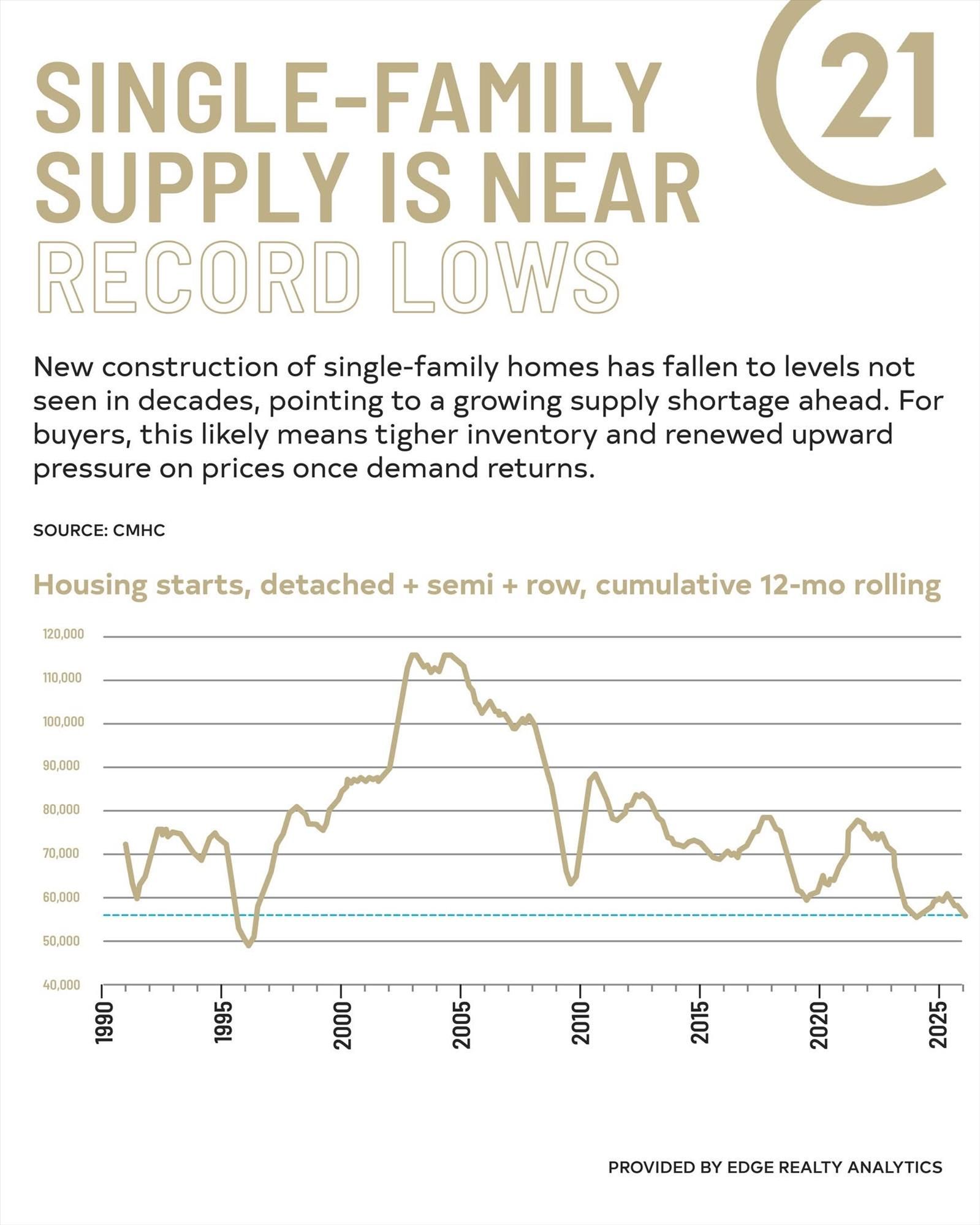
But buried inside those statistics is a quieter shift that has serious implications for buyers, sellers, and anyone tracking the long-term direction of home prices: single-family and ground-oriented housing starts have fallen sharply, and are now running near levels last seen around the post-financial-crisis lows of 2009.
The chart sourced from Edge Realty Analytics tells the story clearly. When you isolate detached, semi-detached, and row housing, the backbone of the owner-occupier market, Canada's 12-month rolling starts have been collapsing even as the headline numbers held up. The reason: virtually all of the growth in total starts is coming from purpose-built rentals and large multi-unit apartment projects.
In other words, we're building lots of housing. We're just not building the kind of housing most buyers want to own.
Why the Type of Housing Built Matters
Not all housing starts are created equal for future resale supply.
Rental apartments don't become listings. When a purpose-built rental tower is completed, those units don't flow into the MLS. They don't become competition for the resale townhouse or the semi-detached home a first-time buyer is hoping to find. The only inventory that feeds the ownership market is new single-family and for-sale condo construction and that's exactly what's being cut.
Analysts tracking ownership-oriented construction note it has dropped to some of its weakest relative levels in decades as a share of total national output. CMHC data reflects strong overall start numbers but a pronounced tilt toward rental and multi-unit, leaving the pipeline for new resale-quality ground-oriented homes thin.
Think of it this way: if a market that used to add 1,000 new single-family homes per year is now only adding 500, even a return to "normal" demand levels puts buyers chasing a much smaller flow of fresh inventory. Prices don't need exceptional demand to firm up, they just need normal demand meeting a structurally reduced supply.
The Lag Effect: Today's Slowdown Becomes Tomorrow's Shortage
Construction decisions made today take 18 to 36 months to show up as completed listings. When builders pull back on single-family starts in 2024 and 2025, we feel the inventory consequences in 2026, 2027, and beyond.
Active resale listings in many Canadian markets have already started to plateau or pull back as sales volumes stabilize. CMHC's 2026 Housing Supply Report flagged that despite strong aggregate construction, underlying supply-demand imbalances persist, particularly for ground-oriented, ownership-oriented housing in high-growth regions.
When mortgage rates ease further, or population growth continues to outpace completions, demand will return against a structurally smaller pool of available homes. That combination tends to firm prices, not weaken them, regardless of how the headline "affordability" narrative reads in any given quarter.
For buyers: The window of relative calm may be shorter than it appears. Waiting for prices to fall further assumes a supply pipeline that simply isn't there for single-family homes.
For sellers: Constrained new supply acts like a floor under prices. Deep, sustained price corrections require either a demand collapse or a flood of new listings and neither looks probable given current fundamentals.
Halifax: Cranes in the Sky, Shortage on the Ground
Halifax is one of the most instructive local examples of this national trend and one we've been tracking closely in our Halifax housing starts analysis.
Halifax had one of the strongest construction booms in the country in 2025, with housing starts rising over 30% year-over-year in the first 10 months of the year and more than 13,000 units under construction at peak. By any measure, it looked like a supply response to the region's well-documented housing shortage.
But look at what's actually being built: approximately 80% of those new Halifax starts were rental apartments. The cranes filling the downtown skyline are almost entirely delivering units that will never appear as MLS listings. For a buyer hoping that all this construction will translate into more single-family homes to choose from, the pipeline is far thinner than the activity level suggests.
That reality shows up in our ongoing Halifax-Dartmouth market statistics: even through a period of record construction, resale inventory for ground-oriented homes has remained constrained, and prices have held their ground with modest but consistent appreciation.
Nova Scotia's Supply Gap: Bigger Than the Build Rate Suggests
The province-wide picture reinforces the point. Nova Scotia has seen elevated overall starts, but the tilt toward multi-unit rental is pronounced, and ground-oriented ownership product has remained a minority of what gets built.
Earlier estimates suggested Halifax alone needed around 17,500 additional units just to catch up to existing demand, with the shortfall potentially widening to over 30,000 by 2027 if construction rates don't accelerate. Province-wide housing deficit projections have ranged as high as 71,600 units needed by 2032 to keep pace with population growth and household formation.
Because the bulk of what's being built is apartments, not detached homes, semis, or rows, that gap is not closing in the segment where most ownership-market buyers compete.
We've seen Halifax's Housing Accelerator Fund initiatives and new as-of-right zoning reforms generate genuine activity, and those policies matter for long-term supply. But policy and zoning changes take years to move through design, approvals, and construction. The single-family pipeline shortage is a near-term reality regardless of what eventually gets permitted.
What This Means If You're Buying or Selling in 2026
The broader Nova Scotia real estate market is in a moment of relative balance, more inventory than the peak frenzy of 2021-2023, more negotiating room, and longer average days on market. For buyers, that's a real window.
But the single-family supply data suggests that window is structural rather than permanent. The conditions creating today's relative calm, higher rates, buyer hesitation, a post-pandemic hangover, are cyclical. The depleted single-family construction pipeline is not. It will take years of sustained ground-oriented building to meaningfully rebuild the ownership supply buffer.
For buyers considering whether to wait: the resale competition you're avoiding today may be considerably more intense in 18 to 24 months if rates continue to ease and demand normalizes. The homes you're hesitating on now are the listings that won't be replaced quickly by new construction.
For sellers, the floor under single-family prices in Halifax-Dartmouth and across Nova Scotia is firmer than current market sentiment might suggest. Positioning your home correctly and working with current data, not 2022 expectations, is what determines outcomes. If you're thinking about timing a sale, our 2025 Halifax-Dartmouth year-end recap and our January 2026 market update both lay out the seasonal patterns that inform optimal listing windows.
The Bottom Line
The national housing construction boom is real, but it's overwhelmingly delivering rental apartments, not the single-family and ground-oriented ownership homes that feed the resale market. Single-family starts nationally are near cycle lows. In Halifax, four out of five new units are rentals. Nova Scotia's overall housing deficit is still widening in the ownership segments that matter most to buyers.
When demand returns in full, through lower rates, continued immigration, or income growth, it will push against a structurally thin pipeline of new single-family supply. That's not a reason for panic. It is a reason to make decisions based on where the market is actually heading, not where headlines suggest it should be.
Rob Lough is the Broker/Owner of Century 21 Optimum Realty, serving Halifax Regional Municipality, East Hants, and Truro. With 25 years of Nova Scotia real estate experience, including 5 years as a certified Home Inspector , he brings a perspective most agents can't offer. Get in touch to discuss what current supply conditions mean for your specific situation.
Related Resources