Your Complete Guide to Buying a Home in Nova Scotia (2026)
Thinking about buying a home in Nova Scotia? Whether you're a first-time buyer, relocating to Atlantic Canada, or upgrading to your next property, understanding the local real estate market and home buying process is essential for making confident decisions. This comprehensive guide walks you through everything from budgeting and mortgages to closing costs and finding the perfect neighbourhood in Halifax, Dartmouth, or beyond.
With over 25 years of experience in real estate, including 20 years as a REALTOR® and 5 years as a Home Inspector, I bring unique dual expertise to help you navigate your home buying journey with confidence. Learn more about my experience and approach .
Why Buy a Home in Nova Scotia?
Nova Scotia offers stunning coastal landscapes, vibrant communities, and diverse housing options ranging from urban condos in downtown Halifax to waterfront properties along the South Shore. The province's real estate market has shown remarkable resilience, with home prices appreciating steadily while remaining more affordable than major Ontario and British Columbia markets.
Halifax, the province's economic hub, provides an appealing mix of career opportunities, cultural amenities, walkable neighbourhoods, and quality schools. Meanwhile, communities like Dartmouth, Bedford, Truro, and the Annapolis Valley offer their own unique character, from waterfront living to rural tranquility.
The Halifax Dartmouth real estate market saw a 2025 annual average home price of approximately $602,000, and heading into 2026 the market is transitioning toward a more balanced environment with strong underlying fundamentals and growing opportunity for buyers.
Step 1: Determine What You Can Afford
Calculate Your Budget Using GDS and TDS Ratios
Before you start browsing listings, understand how much you can realistically afford. Canadian lenders use two key ratios to assess your mortgage eligibility:
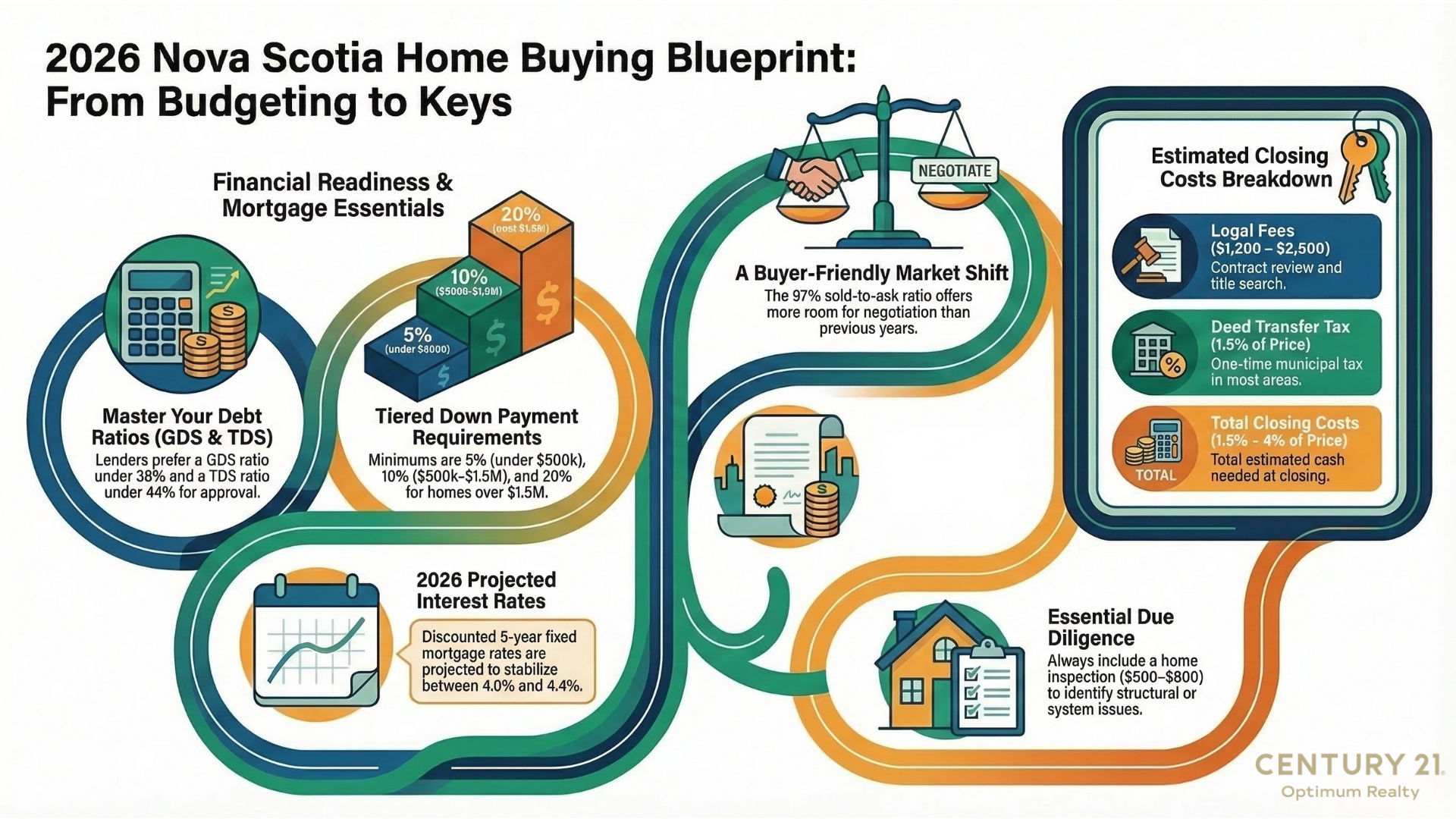
Gross Debt Service (GDS) Ratio: The percentage of your gross monthly income that goes toward housing costs (mortgage payments, property taxes, heating, and condo fees if applicable). Most lenders prefer a GDS ratio of 39% or lower, though staying below 35% gives you better options and financial flexibility.
Total Debt Service (TDS) Ratio: The percentage of your gross monthly income that covers all debts, including housing costs plus car loans, credit cards, student loans, and other obligations. Lenders typically require a TDS ratio of 44% or lower, but staying below 42% strengthens your application.
Understanding these ratios is crucial for mortgage approval and securing favorable interest rates. Read our complete guide to TDS and GDS ratios to learn how to optimize your debt ratios before applying for a mortgage.
Consider All Ownership Costs
Beyond your mortgage payment, budget for:
- Property taxes: Based on your home's assessed value; rates vary by municipality. Learn how Nova Scotia property taxes work
- Home insurance: Required by lenders to protect your investment
- Utilities: Heating, electricity, water, and internet
- Maintenance and repairs: Budget 1 to 3% of your home's value annually
- Condo fees: If purchasing a condominium, monthly fees cover building maintenance and amenities
Down Payment Requirements
- Minimum 5% down payment on the first $500,000 of the purchase price
- 10% on the portion between $500,000 and $1.5 million
- 20% minimum on homes over $1.5 million (insured mortgages are not available above this threshold)
- 20% or more avoids CMHC mortgage default insurance premiums, saving thousands over your mortgage term
New for first-time buyers and new builds: As of December 15, 2024, the federal government expanded eligibility for 30-year mortgage amortizations to all first-time homebuyers and all purchasers of newly built homes with insured mortgages. This longer amortization reduces monthly payments and can make homeownership more accessible, though you'll pay more interest over the life of the mortgage. The insured mortgage price cap was also raised from $1 million to $1.5 million, opening up more housing options for buyers who need mortgage default insurance.
First-time buyers should also explore Nova Scotia's expanded 2026 programs , including the new 2% down payment pilot (the first of its kind in Canada), the enhanced GST rebate of up to $50,000 on new builds under Bill C-4, and the increased $60,000 RRSP Home Buyers' Plan withdrawal limit. Read our complete First-Time Home Buyer Programs in Nova Scotia 2026 Guide for full details on every program available and how they stack together.
Step 2: Get Pre-Approved for a Mortgage
Why Mortgage Pre-Approval Matters
Mortgage pre-approval is one of the most important steps in the home buying process. Meeting with a bank or mortgage broker before house hunting helps you:
- Understand your true budget: Know exactly what you can afford based on your income, debts, and credit
- Strengthen your offers: Sellers view pre-approved buyers as serious and financially qualified
- Lock in rates: Some lenders offer rate holds for 90 to 120 days, protecting you from rate increases
- Shop with confidence: Focus on homes within your price range and avoid disappointment
Special Considerations for Self-Employed Buyers
If you're self-employed, freelance, or run your own business, securing mortgage approval requires additional preparation and documentation. Lenders typically need two years of tax returns, Notice of Assessments from CRA, and may scrutinize your income more carefully. Read our complete guide to getting a mortgage while self-employed for strategies to improve your approval odds and secure competitive rates.
Compare Mortgage Options
When shopping for mortgages, consider:
- Fixed vs. variable rates: Fixed rates offer payment stability; variable rates fluctuate with Bank of Canada policy changes. With the Bank of Canada's overnight rate currently at 2.25% as of early 2026, variable rates remain competitive, though geopolitical and trade uncertainty could influence future decisions.
- Mortgage term length: Common terms range from 1 to 5 years
- Open vs. closed mortgages: Closed mortgages typically offer lower rates but limit prepayment options
- Prepayment privileges: Look for options to make lump sum payments or increase regular payments without penalty
- Portability: Ability to transfer your mortgage to a new property if you move
- Amortization period: First-time buyers and new-build purchasers may now qualify for 30-year amortizations with insured mortgages, reducing monthly payments
- Check out our FREE Mortgage Calculator
Step 3: Choose the Right Location
Research Nova Scotia Neighbourhoods
Location significantly impacts your lifestyle, commute, property value appreciation, and long-term satisfaction. Consider these factors when evaluating neighbourhoods:
- Proximity to work: Calculate your daily commute time and transportation costs
- School quality: Research school ratings if you have or plan to have children
- Amenities: Access to grocery stores, restaurants, parks, recreation facilities, and healthcare
- Community character: Urban, suburban, or rural setting; walkability; demographics
- Future development: Planned infrastructure projects or zoning changes that could impact property values
Popular Nova Scotia Communities for Homebuyers
Halifax Peninsula: Urban living with walkable neighbourhoods, cultural amenities, dining, and nightlife. Higher prices but strong rental demand for investors.
Dartmouth: Growing community with waterfront access, revitalization projects, and more affordable entry points than Halifax Peninsula. Dartmouth remains one of the most desirable neighbourhoods heading into 2026, offering a strong mix of housing options and an easy commute to downtown Halifax. See current Dartmouth market trends .
Bedford: Family-friendly suburb with excellent schools, parks, and amenities. Strong appreciation and high demand. Bedford West is one of the fastest-growing master-planned areas in the region.
Sackville: Affordable suburban option with newer developments, growing amenities, and good highway access to Halifax. A strong choice for families seeking a suburban lifestyle at a more accessible price point.
Truro: Central Nova Scotia hub offering small-town living with big-box shopping, healthcare facilities, and significantly lower prices than HRM.
South Shore: Coastal communities like Chester, Mahone Bay, and Lunenburg offer waterfront living and tourism-driven economies.
Annapolis Valley: Agricultural region with charming towns, vineyards, lower property costs, and access to the Bay of Fundy.
Stay Informed About Market Trends
Nova Scotia's real estate market is transitioning from the rapid appreciation of recent years into a more balanced, sustainable environment. Being informed about current market conditions helps you act decisively when the right property becomes available. Sign up for my free newsletter to receive regular market updates, new listings, and home buying tips.
Step 4: Start Your Home Search
Work with an Experienced Local REALTOR®
While you can browse listings online independently, partnering with a qualified REALTOR® provides significant advantages:
- Access to MLS listings: See properties as soon as they hit the market
- Market expertise: Understand neighbourhood pricing, market conditions, and property values
- Negotiation skills: Professional representation during offers and counteroffers
- Network connections: Access to mortgage brokers, home inspectors, lawyers, and other professionals
- Time savings: Your agent handles scheduling, research, and paperwork
My 25 years in real estate, including 5 years as a Home Inspector, give me unique insight into property condition, potential issues, and true value. View current listings and contact me to start your home search.
Attend Open Houses and Private Viewings
Visit multiple properties to refine your preferences and compare features, layouts, condition, and locations. Take notes and photos (with permission) to help remember each property. Pay attention to:
- Natural light and room flow
- Storage space and closet size
- Basement condition and potential for finishing
- Lot size, yard condition, and landscaping
- Neighbourhood noise levels and traffic
- Proximity to amenities you value
Step 5: Make an Offer
The Offer Process in Nova Scotia
When you find the right property, your REALTOR® will help you prepare an Offer to Purchase, which typically includes:
- Purchase price: Your proposed amount based on market analysis and comparable sales
- Deposit: Usually $1,000 to $5,000 held in trust, applied to your down payment at closing
- Conditions (subjects): Protective clauses like financing approval, satisfactory home inspection, and acceptable condo documents (if applicable)
- Closing date: When you take possession, typically 30 to 90 days from acceptance
- Inclusions and exclusions: Which items stay with the property (appliances, light fixtures, window coverings)
- Expiry time: Deadline for seller response, typically 24 to 48 hours
Negotiation and Counter-Offers
Be prepared for negotiation. Sellers may counter your initial offer with a different price, closing date, or conditions. Your REALTOR® guides you through this process, protecting your interests while working toward an agreement both parties accept.
In the current 2026 market environment, buyers are finding more room to negotiate than in previous years. With the sold-to-ask ratio trending around 97.5% and days on market averaging over 50 days, there's meaningful opportunity to:
- Negotiate on price without the pressure of multiple competing offers
- Include conditions for financing and home inspections
- Request repairs or price adjustments based on inspection findings
- Take time for second viewings and due diligence before committing
In competitive situations or with desirable properties, you may still need to present a strong offer, but the frantic bidding wars that dominated 2021 through 2023 have largely subsided.
Step 6: Complete Due Diligence
Home Inspection
Never skip the home inspection. A qualified inspector examines the property's structure, systems, and components, identifying potential issues with the foundation, roof, electrical, plumbing, HVAC, and more. Home inspections typically cost $500 to $800 but can save you tens of thousands by uncovering problems before you commit.
My background as a Home Inspector for 5 years gives me unique insight into property conditions and helps my clients understand inspection reports and negotiate repairs or price adjustments when issues arise.
Property Appraisal
Your lender may require an appraisal to confirm the property's value supports the mortgage amount. This protects both you and the lender from overpaying. Appraisals typically cost under $700.
Legal Review and Title Search
Your real estate lawyer conducts a title search to verify clear ownership, checks for liens or encumbrances, and ensures the property can be legally transferred. They also review all contracts and explain your legal obligations.
Step 7: Understand Your Closing Costs
Closing costs represent additional expenses beyond your down payment, typically ranging from 1.5% to 4% of the purchase price. Understanding these costs prevents surprises and ensures you have sufficient funds at closing.
Deed Transfer Tax (Land Transfer Tax)
The Deed Transfer Tax is a one-time municipal fee calculated as a percentage of your purchase price or assessed value (whichever is higher). Most Nova Scotia municipalities charge the maximum rate of 1.5% , though some charge less.
Example: On a $500,000 home in Halifax (1.5% rate), you'll pay $7,500 in Deed Transfer Tax.
Non-resident buyers face an additional 5% provincial deed transfer tax unless they establish residency within six months of purchase. Note that Canada's foreign buyer ban (the Prohibition on the Purchase of Residential Property by Non-Canadians Act) remains in effect through December 31, 2026, restricting most non-Canadians from purchasing residential property. Permanent residents and certain temporary residents are exempt.
Learn more about Deed Transfer Tax rates across Nova Scotia municipalities and how this tax impacts your closing budget.
Other Closing Costs to Budget For
| Cost Type | Typical Amount | Description |
|---|---|---|
| Legal Fees | $1,200 to $2,500 | Contract review, title search, document preparation, registration |
| Title Insurance | $250 to $400 | Protects against title defects (alternative to property survey) |
| Property Survey | $1,000 to $2,000 | Confirms property boundaries (if required by lender) |
| Home Inspection | $500 to $800 | Professional assessment of property condition |
| Property Tax Adjustment | Varies | Reimburse seller for prepaid taxes from closing date to year end |
| Utility Adjustments | Varies | Reimburse seller for prepaid oil, propane, or other utilities |
| Home Insurance | $1,000 to $2,000/year | Required by lenders; first year often paid at closing |
| Moving Costs | $500 to $3,000+ | Professional movers or truck rental |
| Appraisal Fee | $300 to $700 | If required by lender |
Read our detailed breakdown of Nova Scotia closing costs to ensure you're fully prepared for all expenses associated with your purchase.
Step 8: Close the Deal and Move In
Closing Day Process
On closing day (usually at your lawyer's office):
- Final walkthrough: Visit the property shortly before closing to ensure agreed-upon repairs are completed and the property is in the expected condition
- Sign documents: Your lawyer guides you through mortgage documents, transfer paperwork, and other legal forms
- Provide certified funds: Bring a bank draft or certified cheque for your down payment and closing costs
- Receive keys: Once all documents are signed and funds transferred, you receive the keys to your new home!
Post-Closing Checklist
- Change locks: For security, rekey or replace locks
- Transfer utilities: Set up accounts for electricity, heating fuel, water, internet, and other services
- Update your address: Notify CRA, banks, employer, insurance providers, and government agencies
- Arrange home insurance: Ensure coverage is active from closing day
- Plan renovations: If making changes, prioritize based on budget and timeline
- Meet your neighbours: Introduce yourself and start building community connections
- Understand property tax obligations: Learn about Nova Scotia's property tax system , including the Capped Assessment Program that can limit tax increases for eligible homeowners
Nova Scotia Real Estate Market Insights (2026)
Understanding current market conditions helps you make informed decisions and set realistic expectations.
Current Market Snapshot
- Average home price (Halifax Dartmouth): $557,476 in February 2026 (seasonal low); 2025 annual average was approximately $602,000
- Market conditions: Transitioning from a seller's market toward a more balanced environment with growing inventory and increased buyer opportunity
- Days on market: 54.1 days average in February 2026, up from the summer 2025 pace of 28–34 days
- Sold to ask ratio: 97.5% in February 2026, down from over 100% during the competitive summer months of 2025, indicating meaningful room for negotiation
- Active inventory: 901 listings as of January 2026, up from 758 a year earlier, giving buyers more choice and less pressure
- Year-over-year price change: Essentially flat at -0.6% for February, reflecting seasonal patterns rather than structural decline
What This Means for Buyers in 2026
The Halifax-Dartmouth market has shifted meaningfully from the frenzy of 2021 through 2023 into a more sustainable, buyer-friendly environment. Here's what that means in practical terms:
More time to decide: With homes averaging over 50 days on market, buyers can book second viewings, arrange inspections, and make thoughtful decisions without being rushed into competing offers.
Negotiation is back: The sold-to-ask ratio below 98% means sellers are accepting offers below asking price. Well-prepared buyers with pre-approval and strong offers are finding real value.
Growing inventory: Rising listing counts mean more options across property types and neighbourhoods, reducing the frustration of limited choice that characterized previous years.
Stable underlying values: Despite seasonal dips, the 2025 annual average held around $602,000, and the market fundamentals — population growth, economic diversity, and relative affordability compared to other Canadian cities — remain strong for long-term appreciation.
View detailed Halifax Dartmouth market statistics and trends to stay informed about the latest developments in your preferred area.
Frequently Asked Questions
What are the total closing costs when buying a home in Nova Scotia?
Expect closing costs between 1.5% and 4% of the purchase price, including legal fees, Deed Transfer Tax, property tax adjustments, home inspection, and other expenses. On a $500,000 home, budget $7,500 to $20,000 for closing costs. Get a detailed breakdown of all closing costs .
Do I need a real estate agent to buy a home in Nova Scotia?
While not legally required, working with an experienced REALTOR® provides significant advantages including MLS access, market expertise, negotiation skills, and professional guidance through complex transactions. Buyer representation is typically paid by the seller, so there's no cost to you. Learn about my approach and experience .
How much do I need for a down payment in Nova Scotia?
Minimum down payments are 5% on the first $500,000, 10% on the portion between $500,000 and $1.5 million, and 20% on amounts over $1.5 million. Putting down 20% or more eliminates CMHC insurance premiums, reducing your total borrowing costs. The insured mortgage price cap was raised from $1 million to $1.5 million in December 2024, opening up more options for buyers with less than 20% down.
Can first-time buyers get a 30-year mortgage?
Yes. As of December 15, 2024, all first-time homebuyers and all purchasers of newly built homes are eligible for 30-year amortizations on insured mortgages. This reduces your monthly payment compared to a 25-year amortization, though you'll pay more in total interest over the life of the loan. Speak with your mortgage broker about whether this option makes sense for your financial situation.
What programs are available for first-time home buyers in Nova Scotia in 2026?
First-time buyers in Nova Scotia have more financial assistance available than ever before. Major programs include the federal GST rebate of up to $50,000 on new builds (under Bill C-4), the $60,000 RRSP Home Buyers' Plan withdrawal limit with a two-year repayment grace period, the First Home Savings Account (FHSA) with $40,000 lifetime contribution room, the $1,500 First-Time Home Buyers' Tax Credit, and Nova Scotia's groundbreaking 2% down payment pilot program delivered through participating credit unions. Read our complete First-Time Home Buyer Programs in Nova Scotia 2026 Guide for eligibility details and how to combine these programs.
How do property taxes work in Nova Scotia?
Property taxes are calculated based on your property's assessed value multiplied by your municipality's tax rate. The Capped Assessment Program limits annual assessment increases to the inflation rate for eligible owner-occupied properties, protecting long-term homeowners from dramatic tax increases. Read our complete Nova Scotia property tax guide .
Can I get a mortgage if I'm self-employed?
Yes, but self-employed buyers typically need two years of tax returns, Notice of Assessments, and may face closer income scrutiny. Having strong credit, a larger down payment, and well-organized financial records improves approval odds. See our self-employed mortgage guide for detailed strategies.
What is the Deed Transfer Tax and how much will I pay?
The Deed Transfer Tax (also called Land Transfer Tax) is a one-time municipal fee paid at closing, typically 1.5% of the purchase price or assessed value (whichever is higher) in most Nova Scotia municipalities. Non-residents pay an additional 5% provincial surcharge unless they establish residency within six months. Learn about DTT rates across Nova Scotia .
Can non-Canadians buy property in Nova Scotia?
Canada's foreign buyer ban (the Prohibition on the Purchase of Residential Property by Non-Canadians Act) remains in effect through December 31, 2026. Most non-Canadians are prohibited from purchasing residential property with three or fewer dwelling units in census metropolitan areas and census agglomerations. Permanent residents, certain temporary residents with valid work permits, and refugee claimants are exempt. The ban does not apply to vacant land or properties with four or more units.
Ready to Start Your Nova Scotia Home Search?
Buying a home is one of life's most significant decisions, and having an experienced professional by your side makes all the difference. With 25 years in real estate, including 20 years as a REALTOR® and 5 years as a Home Inspector, I bring unique dual expertise to help you find the right property, negotiate effectively, and navigate the complexities of home buying with confidence.
Whether you're searching for a downtown Halifax condo, a family home in Dartmouth or Bedford, a waterfront property on the South Shore, or a rural retreat in the Annapolis Valley, I'm here to help you achieve your homeownership goals.
Browse current listings | Contact me to get started | Sign up for market updates