
Halifax Home Inspections: A Former Inspector's Guide to What Really Gets Flagged
By Rob Lough, Broker/Owner | Century 21 Optimum Realty | Halifax-Dartmouth, Nova Scotia
Before I sold my first house, I inspected over 1200 of them.
Five years as a certified home inspector across Halifax Regional Municipality taught me something that most buyers never get to learn until it is too late: the problems that cost you the most money are almost never the ones you can see on a showing. They are in the attic. Behind the drywall. Under the slab. Buried in the wiring.
Halifax presents a particular challenge. The combination of a coastal climate, some of the oldest housing stock in Atlantic Canada, and geology that creates serious radon exposure means buyers here face a unique set of risks. This guide walks through exactly what a trained inspector evaluates, what findings matter most in this market, and how to use that information to protect yourself.
Starting at the Bottom: Foundation and Basement
No part of a Halifax home reveals more about its history than the foundation, and no part causes more expensive surprises for buyers who do not know what to look for.
A significant portion of homes in Halifax were built before World War II, many sitting on stone rubble or early poured concrete foundations that were engineered for a different era. These foundations were designed to keep a root cellar dry, not to support a finished rec room. When homeowners eventually finished these basements, the moisture management infrastructure that should have come first often never got installed.
What an inspector assesses here includes crack patterns in foundation walls and floors (hairline cracks read differently than horizontal or stair-step cracks, which signal structural movement), evidence of water infiltration such as white efflorescence deposits or tide marks on concrete, sump pump operation if one is present, and whether the lot grading directs water away from the building on all sides.
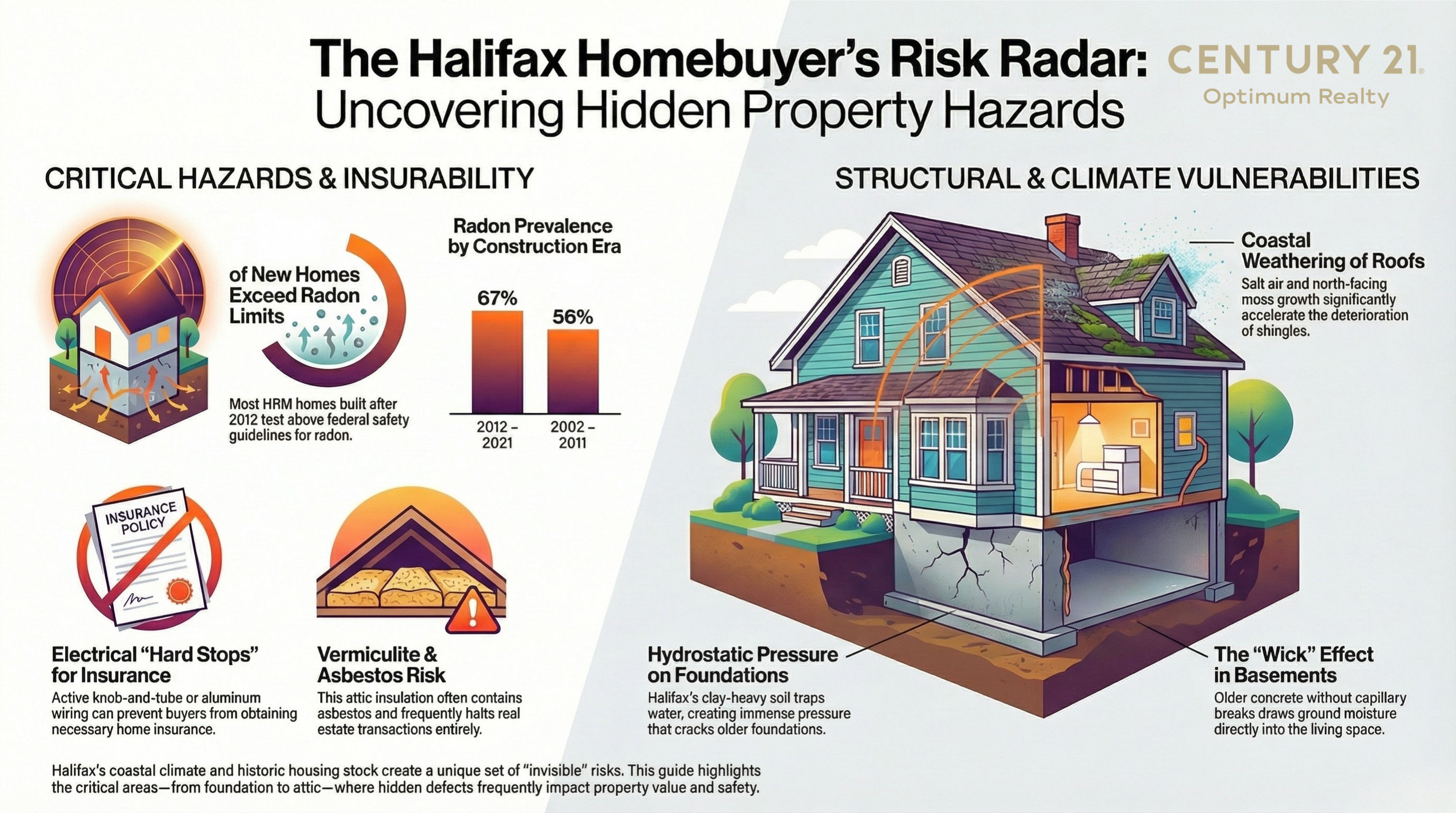
The clay-heavy soil common across much of HRM holds water and creates hydrostatic pressure against foundation walls after heavy rain. Halifax gets a lot of heavy rain.
The Roof: Where Coastal Climate Wins
Roof replacement in Halifax is expensive, typically $9,000 to $17,000 or more depending on size and pitch. That makes the roof one of the highest-priority evaluation points in any inspection.
Inspectors look for physical damage to shingles, including wind lift, cracking, and granule loss that accelerates in Halifax's salt air environment. Flashing failures around chimneys, skylights, and roof-to-wall connections are a consistent finding in older HRM homes. Gutters and downspouts get checked for blockages and proper positioning, since water that pools at the foundation will eventually find its way inside. Attic ventilation is evaluated because inadequate airflow through the attic creates conditions for ice damming in winter and moisture buildup year-round.
Moss growth on north-facing roof sections is common in Halifax and holds moisture against shingles in a way that significantly accelerates their deterioration. A roof facing the Bedford Basin or the harbour simply weathers faster than the same product installed on a sheltered Sackville lot.
Electrical: The Insurability Problem
Electrical deficiencies end more Halifax real estate transactions than almost any other single issue, largely because of how directly they affect a buyer's ability to get insurance and therefore financing.
Knob-and-tube wiring is the primary concern in pre-1945 homes. Most Nova Scotia insurers will not underwrite a home with active knob-and-tube, which creates a hard stop: no insurance, no mortgage. An inspector tests outlets with a circuit analyzer to detect its presence even where the wiring itself is hidden behind walls.
Aluminum wiring shows up in 1960s and 1970s construction and creates fire hazard at connection points if the wrong outlets and switches have been used. It is manageable with proper remediation but needs to be disclosed and priced accordingly.
Panel issues including Federal Pacific and Zinsco breaker panels, double-tapped circuits, and undersized service are evaluated because failure to trip during overload conditions creates serious safety risk.
GFCI protection near all water sources is a code requirement that older Halifax homes frequently fail to meet.
Plumbing: Age Tells the Story
A home's plumbing reveals a great deal about when it was built and how it has been maintained.
Galvanized steel pipes, common in pre-1970s Halifax construction, corrode internally over decades, gradually restricting flow until the system fails. Polybutylene pipe, installed from the late 1970s through the 1990s, carries risk of sudden failure and has been subject to class action litigation in Canada.
The inspector runs multiple fixtures simultaneously to assess real-world water pressure and drain speed. Slow drainage points toward root intrusion or partial blockage in the main sewer line, both of which can develop into significant repair costs.
Water heater age and condition get evaluated as well. Most tank units have an 8 to 12 year service life. The inspector checks the manufacture date and looks for corrosion, rust staining, and whether the pressure relief valve is functional.
Where septic systems are still in use (more common than many buyers realize in areas just outside the central Halifax and Dartmouth core), a dedicated septic inspection is recommended separately from the standard home inspection. This should include tank pumping and leaching bed assessment.
Heating and Ventilation: Essential in Atlantic Canada
A reliable heating system is not optional in Halifax. Winters regularly push well below minus 10 degrees Celsius, and heating failures in older homes can cause serious damage within hours.
The inspector evaluates furnace and boiler age and condition, with units beyond 20 years considered end-of-life regardless of apparent function. Heat exchangers are checked for cracks that allow carbon monoxide to enter the living space. Mini-split heat pumps, now nearly universal in Halifax as either primary or supplemental heat sources, get checked for proper refrigerant line condition and outdoor unit integrity.
Ductwork in older homes frequently has gaps, rust, or disconnected sections that waste heat and reduce comfort. The inspector notes all of these.
Bathroom and kitchen exhaust fans must vent to the exterior. Venting into the attic instead, a surprisingly common shortcut in older renovations, creates guaranteed moisture and mould problems in the attic space above. This is one of the more consistent findings in Halifax's older housing stock.
The Attic: Where History Gets Written
Experienced inspectors treat the attic as a diagnostic archive. It reveals previous leaks, ventilation decisions made decades ago, insulation choices, and sometimes hazards that buyers find genuinely alarming.
Insulation depth and type get measured against current recommendations. Halifax attics should reach R-50 for reasonable energy performance in our climate. Many older homes fall well short.
Vermiculite insulation is the finding that most consistently stops a transaction. This small, grey-brown granular material was used widely in Canada through the 1970s and is frequently contaminated with asbestos from the Libby, Montana processing facility. Health Canada guidance is clear: if vermiculite is present, assume it may contain asbestos and do not disturb it. Professional assessment and potentially abatement are the next steps.
Sheathing condition tells the story of any roof leaks that have occurred over the building's lifetime. Water stains, delamination, and rot on the underside of roof boards indicate water has gotten in, whether recently or historically.
Wildlife access is noted when present. Raccoons and squirrels in particular cause significant damage to insulation and wiring when they establish themselves in Halifax attics.
Radon: Halifax's Most Overlooked Risk
Radon is invisible, odourless, and responsible for more lung cancer deaths in Canada than any cause other than smoking. It is also a documented, serious problem in Halifax that most buyers never think to ask about.
Health Canada testing data for HRM is striking: among homes built between 2012 and 2021, 67% tested above the 200 Bq/m³ federal guideline. More than one in four of those homes exceeded 600 Bq/m³, which is considered extremely elevated. Even homes built in the preceding decade showed 56% above guideline levels.
The gas forms from uranium decay in bedrock and soil, enters homes through foundation cracks and sump openings, and accumulates indoors particularly in tightly built, energy-efficient homes. Testing is not part of a standard inspection, but any inspector worth hiring in Halifax will specifically recommend it.
A long-term radon test runs a minimum of 91 days. Mitigation through sub-slab depressurization typically costs between $2,000 and $3,000 and is highly effective. This should be treated as a non-negotiable step in any Halifax home purchase, not an optional add-on.
Moisture and Mould
Halifax's rainfall totals, harbour humidity, and aging housing stock create near-ideal conditions for moisture-related problems. An inspector looks for active leaks at windows, ceilings, and plumbing penetrations; visible mould in attics, crawl spaces, and behind bathroom fixtures; condensation patterns on windows that suggest inadequate interior ventilation; and musty odours that an experienced nose identifies quickly even before visible mould is found.
Older Halifax homes built without capillary breaks between concrete and soil act like wicks, drawing ground moisture into basements continuously. Without mechanical ventilation to compensate, that moisture has nowhere to go except into the building materials and air.
Exterior, Safety Systems, and Site Conditions
The inspection begins before the inspector enters the home. Siding condition, window and door seal integrity, deck and railing safety, driveway heaving, tree proximity to the foundation, and retaining wall stability on Halifax's hilly lots are all evaluated from outside.
Safety systems including smoke detectors on every level, carbon monoxide detectors near fuel-burning appliances, and GFCI outlets near water sources are quick checks but genuinely important findings when they are absent.
Properties near the coast or the Shubenacadie Lakes system warrant attention to HRM's documented flood risk mapping. The municipality has identified over 1,200 properties in potentially affected zones.
The Limits of a Standard Inspection
A home inspection is visual and non-invasive. Inspectors do not open walls, move stored items, or provide cost estimates for repairs. Radon testing, mould air quality sampling, sewer camera scopes, and septic assessments are all separate engagements with separate professionals.
Choosing an inspector carefully matters in Nova Scotia because home inspectors are not licensed by any provincial authority. Look for membership in CAHPI or InterNACHI, confirmed Errors and Omissions insurance, demonstrated experience with Halifax's building stock specifically, and a sample report you can review before hiring.
Frequently Asked Questions
Do I need a home inspection if the home is newly built? Yes. New construction in Halifax is not exempt from deficiencies. Inspectors regularly find issues in brand new homes including improper grading, ventilation shortcuts, missing insulation, and code violations that slipped through the building permit process. A new build inspection is different from a resale inspection but equally worthwhile.
What is a pre-listing inspection and should sellers get one? A pre-listing inspection is done by the seller before putting the home on the market. It identifies issues in advance so they can be repaired or disclosed upfront, reducing the chance of a deal collapsing after a buyer's inspection. In a more balanced market like Halifax is experiencing in 2026, pre-listing inspections have become a stronger selling strategy.
Can an inspector tell me how much repairs will cost? No. Repair cost estimation is outside the scope of a standard home inspection. The inspector identifies and categorizes deficiencies. Getting actual repair quotes from qualified contractors is a separate step, and one you should complete before finalizing any negotiation based on the report.
What is the difference between a short-term and long-term radon test? A short-term test uses an electronic monitor over a few days and gives a screening result. A long-term test uses a passive device left in place for a minimum of 91 days and provides a much more accurate picture of actual exposure. Health Canada recommends long-term testing for real estate transactions. If a short-term test shows elevated levels, a long-term test should follow before drawing conclusions.
What happens if the seller refuses to negotiate after a bad inspection? That depends on what your offer says. If you have an inspection condition, you can walk away and recover your deposit. If you waived the condition, your options are more limited. This is one of the main reasons having a clear offer strategy before you find a home matters as much as finding the home itself.
Are there inspections beyond the standard home inspection I should consider in Halifax? Several. A sewer scope camera inspection is worth considering for homes over 30 years old to check for root intrusion or collapsed lines. A WETT inspection is required by most insurers if the home has a wood stove or fireplace insert. Septic inspections are essential for any property not on municipal sewer. And as covered throughout this article, radon testing should be treated as standard for any Halifax purchase.
How do I know if an inspector is qualified in Nova Scotia? Because home inspectors are not provincially licensed in Nova Scotia, your best verification tools are professional association membership (CAHPI or InterNACHI), confirmed Errors and Omissions insurance, and a sample inspection report reviewed before you hire. Ask your Realtor for referrals to inspectors they have worked with on multiple transactions and trust.
What should I do if I already bought a home and am now worried about radon or knob-and-tube? Start with testing for radon using a long-term device, available at most hardware stores or through a certified professional. For electrical, contact a licensed Nova Scotia electrician for an assessment. Both issues are treatable. Radon mitigation systems are effective and relatively affordable. Electrical upgrades are more involved but well-understood work. Neither finding means the home is unsalvageable, but both need to be addressed.
What Comes Next
Once the report is in hand, your Realtor should help you understand which findings are deal-relevant and which reflect normal wear on a Halifax home of that vintage. Not every item on an inspection report is a negotiation point. Some findings are simply information about what you are buying.
Before inspection day even arrives, it is worth understanding the full cost picture of a home purchase. The Buyers Guide at roblough.com walks through the buying process from pre-approval through closing, and for the latest on where Halifax prices and market conditions stand right now, the Halifax-Dartmouth market stats at roblough.com/news provide current data with historical context.
A home inspection is one of the best investments in the buying process. In a city with Halifax's age and character of housing stock, it is also one of the most important.
Rob Lough Broker/Owner | Century 21 Optimum Realty (902) 880-8595 | rob.lough@century21.ca | roblough.com
Related Resources