
Canadian Rents Fall for 17th Straight Month
Canadian Rents Fall for 17th Straight Month But Nova Scotia Is Bucking the Trend
Published: March 10, 2026 | By Rob Lough, Broker/Owner, Century 21 Optimum Realty
If you've been watching Canada's rental market, the latest numbers tell a striking story and if you're in Nova Scotia, that story looks very different from the rest of the country.
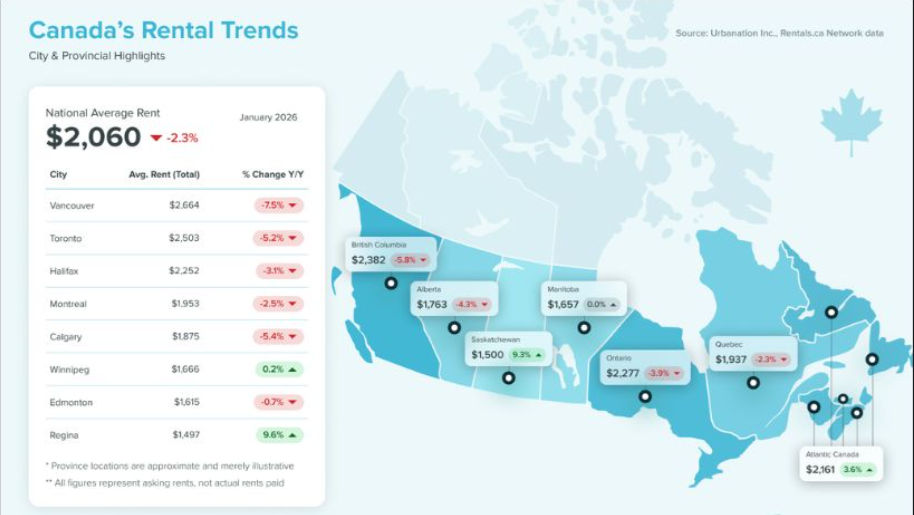
According to the February 2026 National Rent Report from Rentals.ca and Urbanation, average asking rents fell 2.8% year-over-year to $2,030 — the 17th straight month of annual declines Canadian Mortgage Trends. Asking rents have now reached their lowest level in 33 months and are 7.4% below where they stood two years ago. REMINET
For most of the country, renters are getting a rare break. But here in Nova Scotia, the story is the exact opposite.
Nova Scotia Rents Are Rising - Here's Why It Matters
While Ontario, B.C., Alberta, and Quebec are all seeing year-over-year rent decreases, average asking rents in Nova Scotia rose 6.3% year-over-year to $2,307 in February Canadian Mortgage Trends making us one of only three provinces where rents climbed.
That 6.3% increase isn't a blip. It reflects something that anyone active in the Halifax-Dartmouth market already knows: demand here remains strong relative to available supply, and our population growth story isn't slowing the way it is in Ontario or B.C.
What's Driving the National Decline?
The national picture is being shaped by a rare convergence of two forces that rarely move together at the same time.
Demand has weakened while supply has finally arrived. Population growth slowed to just 0.1% in both Q1 and Q2 of 2025, the weakest quarters since 2020, reducing the marginal rental demand that once absorbed new units almost instantly. Valery Real Estate
Urbanation president Shaun Hildebrand describes Canada as undergoing its largest downturn in rents in recent history, with supply arriving at a time when demand has slowed. Canadian Mortgage Trends
February's seasonal slowdown was also sharper than usual, with asking rents declining 1.3% month-over-month — the steepest February drop since 2020. REMINET
The provinces feeling the most pressure: Alberta led with a 4.4% decline, followed by Ontario at 4.3% and B.C. at 4.2%. BNN Bloomberg
The Nova Scotia Exception: Population Inflows and Limited Supply
Nova Scotia has consistently been a net beneficiary of interprovincial migration in recent years. Nova Scotia ranked second only to Alberta in interprovincial migration gains in 2025, posting a net increase of 2,446 residents. liv.rent
That ongoing influx of new residents, many arriving from Ontario and B.C., is sustaining rental demand here in a way that isn't happening nationally. Combined with the fact that new housing takes time to reach completion, this supply-demand gap is keeping asking rents elevated.
For context on how Halifax's broader housing market has been absorbing this demand, see my recent piece on Halifax-Dartmouth Real Estate Market Statistics – January 2026.
What This Means If You're Renting in Nova Scotia
If you're currently renting: You're in a different position than renters in Toronto or Vancouver right now. While national headlines may suggest it's a renter's market, in Nova Scotia, and particularly in HRM, competition for well-priced units remains real. Expect limited concessions from landlords and continued upward pressure on rents through the spring.
If you're a renter considering buying: The rising rental environment in Nova Scotia may accelerate your timeline. When monthly rents approach or exceed carrying costs on a comparable property, the math shifts. Now may be a smart time to explore what ownership actually looks like for your budget.
What This Means If You Own Rental Property in Nova Scotia
If you're a landlord or investor: The national narrative about rent declines doesn't apply to your market the way it does in Alberta or Ontario. Nova Scotia's 6.3% year-over-year increase suggests your asset class continues to perform relative to the rest of Canada. Vacancy risk remains lower here than in most other provinces.
If you're considering adding rental property to your portfolio: The relative insulation of the Nova Scotia market from national decline trends is worth weighing carefully. That said, supply is growing, the Shannon Park development and other new builds will add units to HRM over the coming years. I covered the details of that project here: Nova Scotia and Ottawa Partner on $300M Shannon Park Housing Project.
The Bigger Picture: Is This the New Normal?
For now, the national rental market correction is being described as a structural shift rather than a temporary blip. The forces that pushed rents relentlessly higher have weakened. New forces are now exerting pressure in the opposite direction. The result is not yet a collapse, but it is no longer a one-way market. Valery Real Estate
We saw an early version of this trend last fall, when I wrote about Canada's Rental Market Posts Record Decline. What we're seeing now is that trend deepening nationally, while Nova Scotia continues to swim against the current.
The Bottom Line for Nova Scotia Buyers, Sellers & Investors
The national rental decline is real, but it is not evenly distributed. Nova Scotia is one of the few places in Canada where rental demand is holding firm and asking rents are still climbing. That creates a distinct set of opportunities and considerations for everyone in our market, whether you're renting, investing, or deciding between owning and leasing.
If you want to talk through what this means for your specific situation, whether you're a first-time buyer crunching rent-vs-own numbers, or an investor tracking the Halifax market, reach out directly. I'm happy to run the numbers with you.
Rob Lough | Broker/Owner, REALTOR® Century 21 Optimum Realty | Halifax-Dartmouth, Nova Scotia 📞 (902) 880-8595 | rob.lough@century21.ca
Related Resources
- Halifax-Dartmouth Real Estate Market Statistics – January 2026
- Halifax-Dartmouth Real Estate Market Statistics – Full Year 2025
- Canada's Rental Market Posts Record Decline (December 2025)
- Nova Scotia and Ottawa Partner on $300M Shannon Park Housing Project
- Canadian Housing Market Shows Early Signs of Buyer Activity Heading Into 2026