
Halifax Economic Dashboard 2026
Halifax Economic Dashboard 2026: What the Latest Data Means for Buyers, Sellers, Renters, and Investors
By Rob Lough, Broker/Owner – Century 21 Optimum Realty | Halifax-Dartmouth, NS
If you want a real-time read on Halifax's economy, beyond just home prices and sales volumes, the Halifax Partnership Economic Dashboard is the most current, comprehensive source available. Updated monthly, it tracks labour markets, GDP, rental data, inflation, retail spending, and commercial real estate in one place. For anyone planning a move, listing a home, or evaluating an investment in Halifax Regional Municipality, it's essential reading.
Here's what the latest figures show and what they mean for every type of participant in the Halifax market right now.
Halifax Is Still Outpacing Canada and Nova Scotia, But Normalizing
The headline economic story hasn't changed in character, but the numbers have been refreshed—and they're better than the forecasts suggested even six months ago.
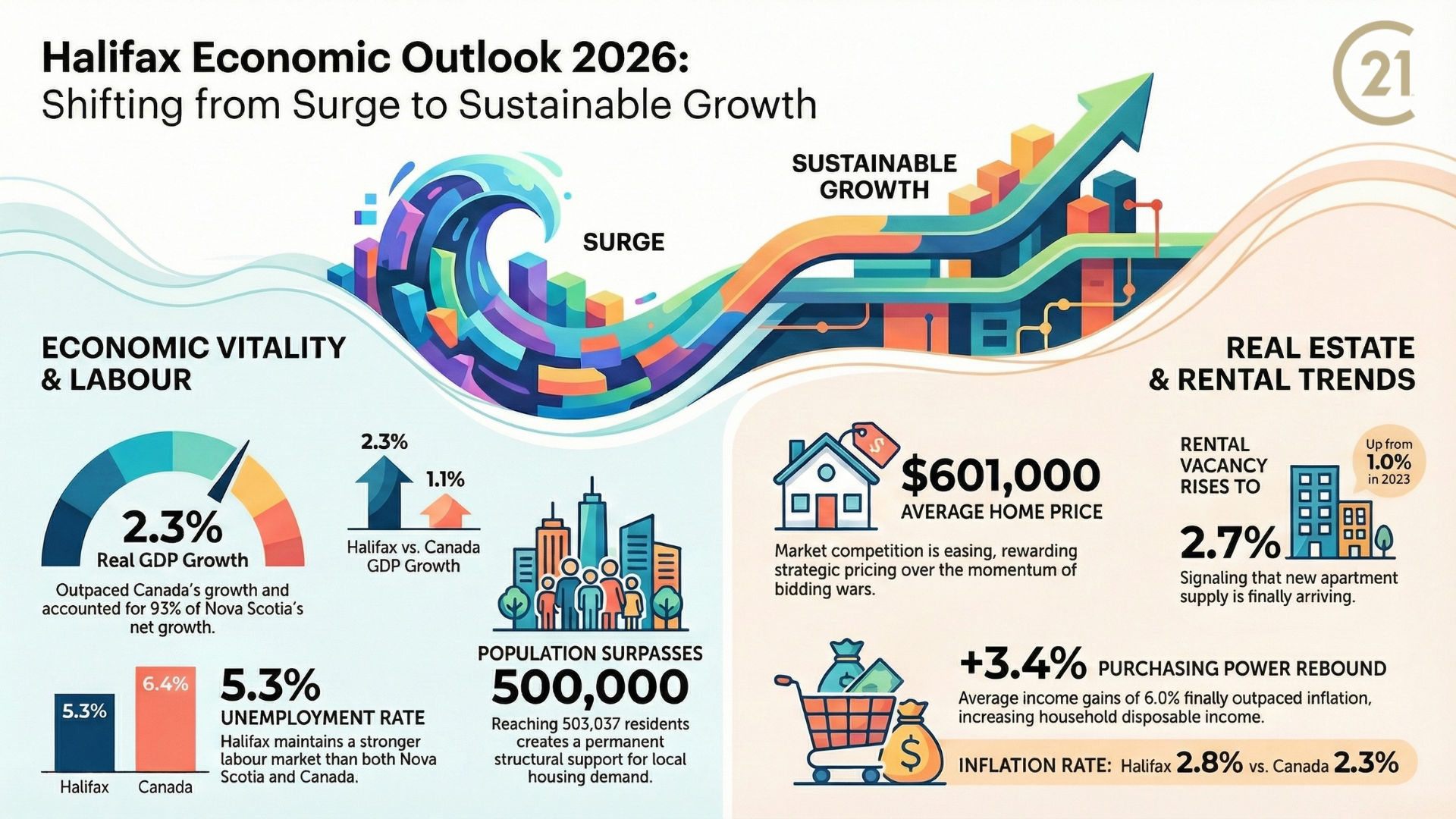
Halifax's real GDP grew 2.3% in 2025, well ahead of Canada (1.1%) and Nova Scotia (1.4%), and Halifax accounted for 93% of Nova Scotia's net real GDP growth that year. Halifax Partnership That's a slight moderation from the 2.6% pace recorded in 2024, but it handily beat the 1.6% forecast that was circulating earlier in the year, a meaningful vote of confidence in Halifax's economic resilience.
Looking ahead, Halifax's economy is expected to grow 1.5% in 2026 and average 1.8% annually between 2027 and 2030. Halifax Partnership That's a shift from surge-level expansion to durable, sustainable growth, exactly what underpins long-term housing demand without overheating affordability.
For context on how this feeds into housing, the Halifax-Dartmouth Real Estate Market Statistics: January 2026 report captures the same normalization theme in transaction data: more days on market, modestly lower sold-to-ask ratios, and a market that rewards strategy over momentum.
Population: Halifax Passes the Half-Million Mark
A milestone worth noting as context for everything that follows: Halifax Regional Municipality's population surpassed 500,000 in 2024, reaching an estimated 503,037, up 11,600 from 2023, and the third-highest annual increase on record. Halifax Partnership
To reach the Economic Strategy's 2027 population goal of 525,000, continued annual growth of 1.4% is required. Halifax Partnership That baseline population pressure, even as growth moderates from peak years, is the single most important structural support for housing demand in HRM. More people means more buyers, more renters, and more demand for commercial and industrial space.
Housing: Firm Prices, Gradually Easing Competition
Average home prices in Halifax remain elevated and, by national standards, remarkably stable. The Halifax Real Estate Market in 2025 recap documents how prices held in the high-$580,000s to $614,000 range throughout the year before settling near $601,000 by year-end, modest appreciation rather than the double-digit jumps of earlier years.
According to RBC's Housing Affordability Measures, 43.4% of income was needed to cover homeownership costs in Halifax in 2024, a slight improvement from 45.3% in 2023. Halifax Partnership That's still a meaningful affordability burden, but the direction is encouraging.
For sellers: The era of automatic bidding wars is behind us, but well-priced, well-presented homes still sell competitively. Review the Nova Scotia Real Estate Market Update for context on how pricing strategy has shifted across different property types.
For buyers: The Buyers Info guide is your starting point, it covers down payment thresholds, GDS/TDS ratios, and Nova Scotia closing costs. The most competitive buyers in today's market have financing locked in and realistic expectations about product selection.
Rentals: Rents Still Climbing, But More Supply Is Arriving
The rental picture shows two competing forces at work and both matter for different stakeholders.
Average monthly rent in Halifax across all apartment types rose 8.0% from $1,616 in 2024 to $1,745 in 2025, while the apartment vacancy rate climbed to 2.7%, up from 2.1% in 2024 and 1.0% in 2023. Halifax Partnership The vacancy improvement is the most significant development for renters in several years, signalling that new supply is finally registering in the market.
The fastest rent increases in 2025 were seen in smaller units, with studio apartment rents rising 15.0% over 2024. Halifax Partnership That's a notable shift from prior years when larger family-sized units led increases, and it points to strong demand from younger singles and newcomers entering the city.
The share of income spent on rent in Halifax reached 36.0% in 2024, up from 34.7% in 2023. Halifax Partnership Affordability for lower-income renters remains a serious concern even as vacancy slowly improves.
The construction backdrop supporting that vacancy recovery is documented in the Halifax Housing Starts 2025 analysis, purpose-built rental apartment starts have dominated new construction activity, backed significantly by federal financing programs.
Labour Market: Still the Strongest in Atlantic Canada
Halifax's employment picture remains one of the most consistently positive storylines in the dashboard.
Halifax's unemployment rate held at 5.3% in January 2026, unchanged over the previous two months, and notably better than Canada (6.4%) and Nova Scotia (6.6%) for the same period. Halifax Partnership Jobs are up 3,200 year-over-year, even with a negligible month-over-month dip of 100 positions.
The sector mix has shifted meaningfully from what it was earlier in 2025. Since January 2025, health care and social assistance has added the most jobs at +5,200, followed by manufacturing at +1,600. In contrast, public administration has shed 2,300 jobs and transportation and warehousing has lost 2,100. Halifax Partnership
That's a notable rotation, the public sector, which propped up employment numbers through mid-2025, is now contracting, while private-sector health care and manufacturing are picking up the slack. For real estate purposes, the key takeaway is that Halifax's labour market fundamentals remain intact, supporting housing demand even as the composition of job growth evolves. For a broader Nova Scotia lens, the Canadian Housing Market Update: Nova Scotia's Outlook places these employment trends in national context.
Inflation and Consumer Spending: Creeping Back Up, But Still Manageable
The inflation picture has shifted since spring 2025, and it's worth updating your expectations accordingly.
Halifax's annual inflation rate reached 2.8% in January 2026, down 0.3 percentage points from the previous month, but 1.4 percentage points higher than a year ago. Canada's national rate eased to 2.3%, and Nova Scotia came in at 2.7%. Halifax Partnership
This is a moderate uptick from the 1.7% reading reported in spring 2025, and it's worth watching in the context of the Bank of Canada's rate decisions. For mortgage holders and buyers planning their budgets, the trend back toward the upper end of the Bank's 1–3% target band means rate cuts are less likely to accelerate than they appeared to be mid-year.
On the retail side, Nova Scotia retail sales increased 3.7% year-over-year in December 2025, with the largest gains recorded by sporting goods, hobby, and miscellaneous retailers (+12.1%) and gasoline stations (+12.1%), while health and personal care retailers saw the largest annual decline at -5.4%. Halifax Partnership
Purchasing Power and Well-Being: The Bigger Picture Is Improving
One of the most underreported stories in the Halifax economic data is the rebound in household purchasing power.
Purchasing power for Halifax residents rose 3.4% in 2024, as average income gains of 6.0% outpaced inflation of 2.6%. Halifax Partnership That reverses three consecutive years of declining purchasing power and has real implications for housing: households with more disposable income are better positioned to absorb elevated home prices and rents, even as those costs remain high in absolute terms.
Well-being measures have rebounded accordingly, with 62.8% of Halifax survey respondents rating their life satisfaction as "high" or "very high" in 2025, up from 58.3% in 2024. Halifax Partnership
That said, challenges remain. Halifax Partnership's chief economist notes that while the economic picture is more optimistic than in 2022–2023, concerns over productivity, stagnant GDP per capita growth, and U.S. tariff threats remain pressing concerns for Halifax's long-term economic growth and quality of life. Halifax Partnership
Commercial Real Estate: Office Improving, Mixed Industrial Signals
The office vacancy rate in Halifax eased to 11.5% in Q3 2025, which was 1.3 percentage points lower than a year ago. Halifax Partnership That's a meaningful improvement from the 12.2–12.8% range reported earlier in 2025 and suggests gradual absorption is continuing even with hybrid work patterns still in place.
For investors and business owners considering commercial space in HRM, the improving office market—combined with ongoing industrial demand tied to Halifax's port and logistics activity, suggests selective opportunity in both sectors as the market continues to rebalance.
What to Watch Going Forward
The Halifax Partnership updates its dashboard monthly, and a few indicators deserve close attention heading into the rest of 2026:
GDP vs. forecast: With 2025 coming in at 2.3%—better than the 1.6% projection—watch whether 2026's 1.5% forecast proves similarly conservative or whether U.S. tariff impacts weigh more heavily than anticipated.
Vacancy vs. rent: If vacancy continues rising from 2.7% toward 3–4%, expect rent growth to moderate. That would ease affordability pressure for tenants but reduce yield expectations for investors acquiring rental properties.
Inflation trajectory: January's 2.8% reading in Halifax is higher than the national average. Any sustained move above 3% would push Bank of Canada decisions in a direction that affects variable-rate mortgage holders and purchase financing.
Labour market composition: The shift from public administration growth to health care and manufacturing warrants monitoring. A broader private-sector employment recovery would be a stronger foundation for sustained housing demand.
Halifax remains, by every objective measure, Nova Scotia's economic engine and one of the most resilient mid-sized metros in Canada. The data doesn't signal a crash or a crisis — it signals a market that has moved from extraordinary to solid, and where thoughtful participants on both sides of a transaction can succeed.
Questions about what these trends mean for your specific purchase, sale, or investment? Contact Rob Lough at Century 21 Optimum Realty — 25 years of Halifax-Dartmouth market experience, backed by the latest economic data.
Related Resources
- Halifax-Dartmouth Real Estate Market Statistics: January 2026
- Nova Scotia Real Estate Market Update
- Halifax Real Estate Market in 2025: Trends, Opportunities, and What Buyers and Sellers Need to Know
- Halifax Housing Starts 2025: A Detailed Market Analysis
- Canadian Housing Market Update: Nova Scotia's Outlook
- Complete Guide to Buying a Home in Nova Scotia
- Halifax Partnership Economic Dashboard
- Halifax Index 2025