
Nova Scotia's Housing Pipeline Is in Trouble
Nova Scotia's Housing Pipeline Is in Trouble And the Numbers Prove It
By Rob Lough, Broker/Owner — Century 21 Optimum Realty, Halifax-Dartmouth
April 2026
Two Stories. One Province. A Collision Course.
Right now, Canada's national housing agency is telling two stories at the same time and for Nova Scotia, they crash into each other in a way that should concern every buyer, seller, and renter in this province.
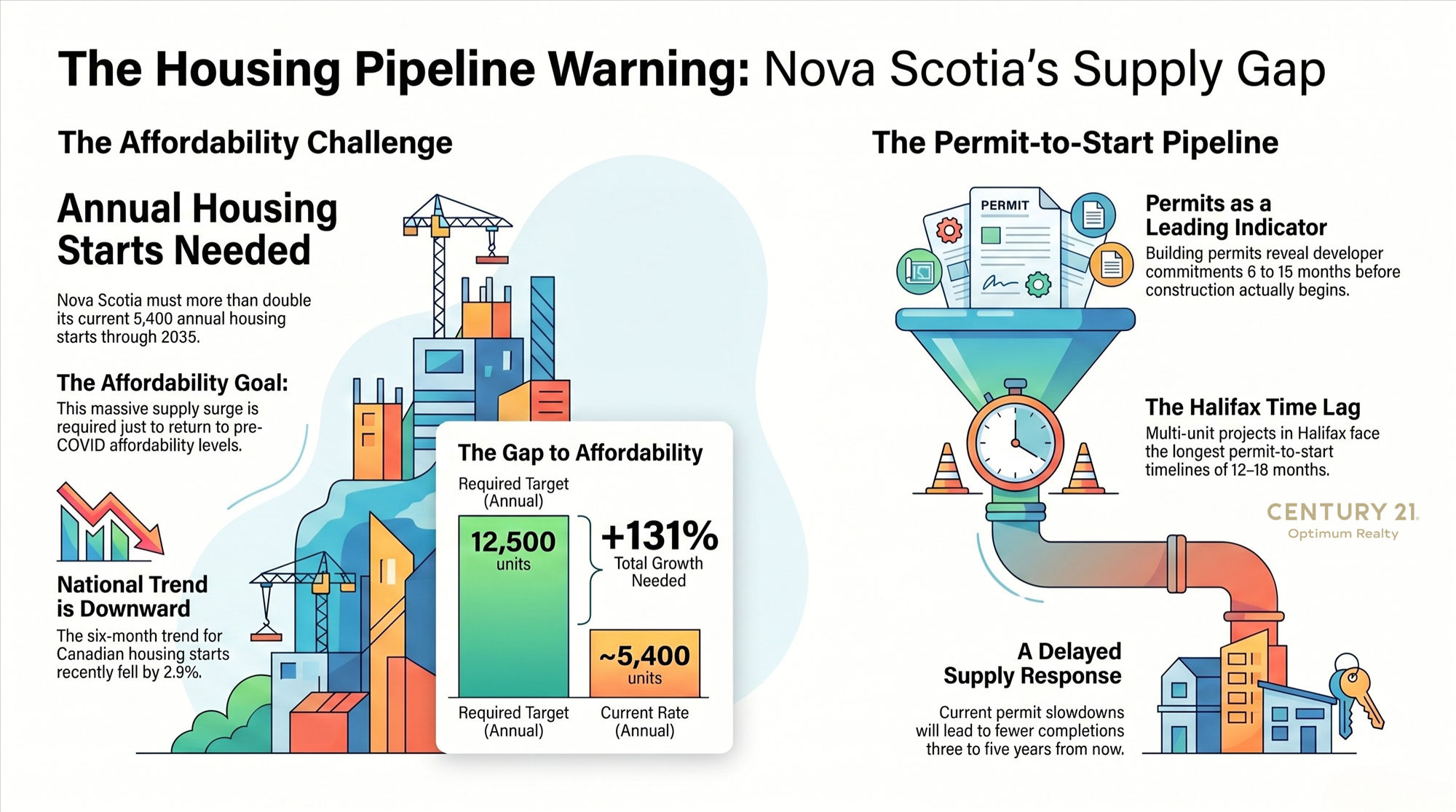
Story One: CMHC's housing supply research says Nova Scotia needs to more than double its annual housing starts, from roughly 5,400 units per year to approximately 12,500, sustained every year through 2035, just to restore the affordability levels we had before COVID. We covered this in detail in our Nova Scotia housing crisis and affordability analysis.
Story Two: In a new Housing Observer article published April 17, 2026, CMHC's Chief Economist Mathieu Laberge explains that building permits, the earliest reliable signal in the construction pipeline, are declining across Canada's major urban centres. And when permits fall, housing starts typically follow, with a lag of roughly 6 to 15 months.
Put them together and you get a serious problem: we're being told we need to dramatically accelerate construction at the exact same time that early indicators suggest momentum is heading in the opposite direction.
Why Permits Matter More Than Starts Right Now
Most people track housing starts. That's the number that gets the headlines. But CMHC's new analysis argues that in today's construction environment, dominated by large, multi-year apartment and rental projects, building permits are actually the more important number to watch.
Here's why: a high-rise apartment in a major city can take 9 to 15 months from building permit to housing start, and years more to complete. By the time a project shows up in the starts data, the market decision was made well over a year ago. Permits tell you what developers are committing to right now. Starts tell you what they committed to last year.
CMHC's data shows apartment permits leading starts by roughly 6 to 15 months across major Canadian cities, with high-rise structures in markets like Toronto and Montreal showing even longer delays. The takeaway: if permits are softening today, expect starts to soften in 2026 and 2027.
Nationally, CMHC's March 2026 data shows the six-month trend in total Canadian housing starts fell 2.9% to a seasonally adjusted annual rate of about 248,000 units, even as raw March numbers showed a year-over-year uptick. The trend is what matters, and the trend is downward.
The Halifax Problem
For Nova Scotia, the city-level permit story lands squarely on Halifax.
CMHC's analysis focuses on Canada's four major CMAs, Toronto, Montreal, Vancouver, and Calgary, but the principle applies directly to HRM. Halifax is where the vast majority of Nova Scotia's multi-unit residential construction happens. Purpose-built rental apartments and mid-rise condominiums are concentrated in the urban core, and those are precisely the project types with the longest permit-to-start timelines.
If permit activity for larger multi-unit projects in HRM is flat or declining, we should expect softer starts in the 12 to 18 months ahead. And softer starts mean fewer completions three to five years from now, exactly when Nova Scotia needs supply to be accelerating, not decelerating.
We've already been tracking the effects of a supply-constrained market in our Halifax-Dartmouth January 2026 market statistics. Inventory is creeping higher, but from a historically low base. Price growth has moderated, but affordability remains a serious challenge for first-time buyers and renters alike.
For Buyers
If you've been waiting for prices to drop significantly because of new supply coming to market, this CMHC data suggests that relief may be further off than you'd hope. The pipeline isn't filling fast enough. If you're in a position to purchase in 2026, balanced market conditions, more listings, more negotiating room, may be as good as it gets in the near term. Learn more about current buying conditions on our Nova Scotia real estate market update.
For Sellers
Tighter supply over the medium term works in sellers' favour, but that doesn't mean you can ignore pricing strategy today. We're in a more balanced market than 2021–2023, and buyers have more options and more patience. Strategic pricing and presentation still matter. See our March 2026 Halifax market stats for how the current balance is playing out on the ground.
The Policy Gap
Nova Scotia and HRM have taken real steps to address supply: as-of-right zoning reforms, the Housing Accelerator Fund targets, HST removal on purpose-built rentals, and provincial directives to speed approvals. We covered the HRM side of this in our Halifax Suburban Housing Accelerator Plan guide.
Those policies matter. But CMHC's permit-to-start analysis is a reminder that policy announcements and actual shovels in the ground are different things. The pipeline between a zoning reform and a completed apartment building runs through permits, financing, labour, and market sentiment, all of which have to line up at once. Right now, nationally, that alignment is slipping.
Nova Scotia needs those conditions to hold together longer and at greater scale than anywhere else in the country on a per-capita basis. Whether current permit activity in HRM reflects that ambition is something worth watching closely in the months ahead.
Bottom Line
CMHC has given us a useful framework: permits lead, starts confirm. Right now, the leading indicators nationally are pointing toward slower construction, not faster. For a province that needs to more than double its annual housing output, that's a warning sign worth paying attention to — regardless of where you sit in the market.
Related Resources
- Nova Scotia Housing Crisis: Why the Province Must Double Construction
- Halifax-Dartmouth Real Estate Market Statistics — January 2026
- Halifax Real Estate Market Stats — March 2026
- Halifax's Suburban Housing Accelerator Plan — Complete Guide
- Nova Scotia Real Estate Market Update
- CMHC: Canada's Construction Pulse — Permits Lead, Starts Confirm (April 17, 2026)