
Nova Scotia Court Rules: Move-Out Cleaning Fee Clauses in Leases Are Unenforceable
Nova Scotia Court Rules: Move-Out Cleaning Fee Clauses in Leases Are Unenforceable
By Rob Lough | Century 21 Optimum Realty | Halifax-Dartmouth, Nova Scotia
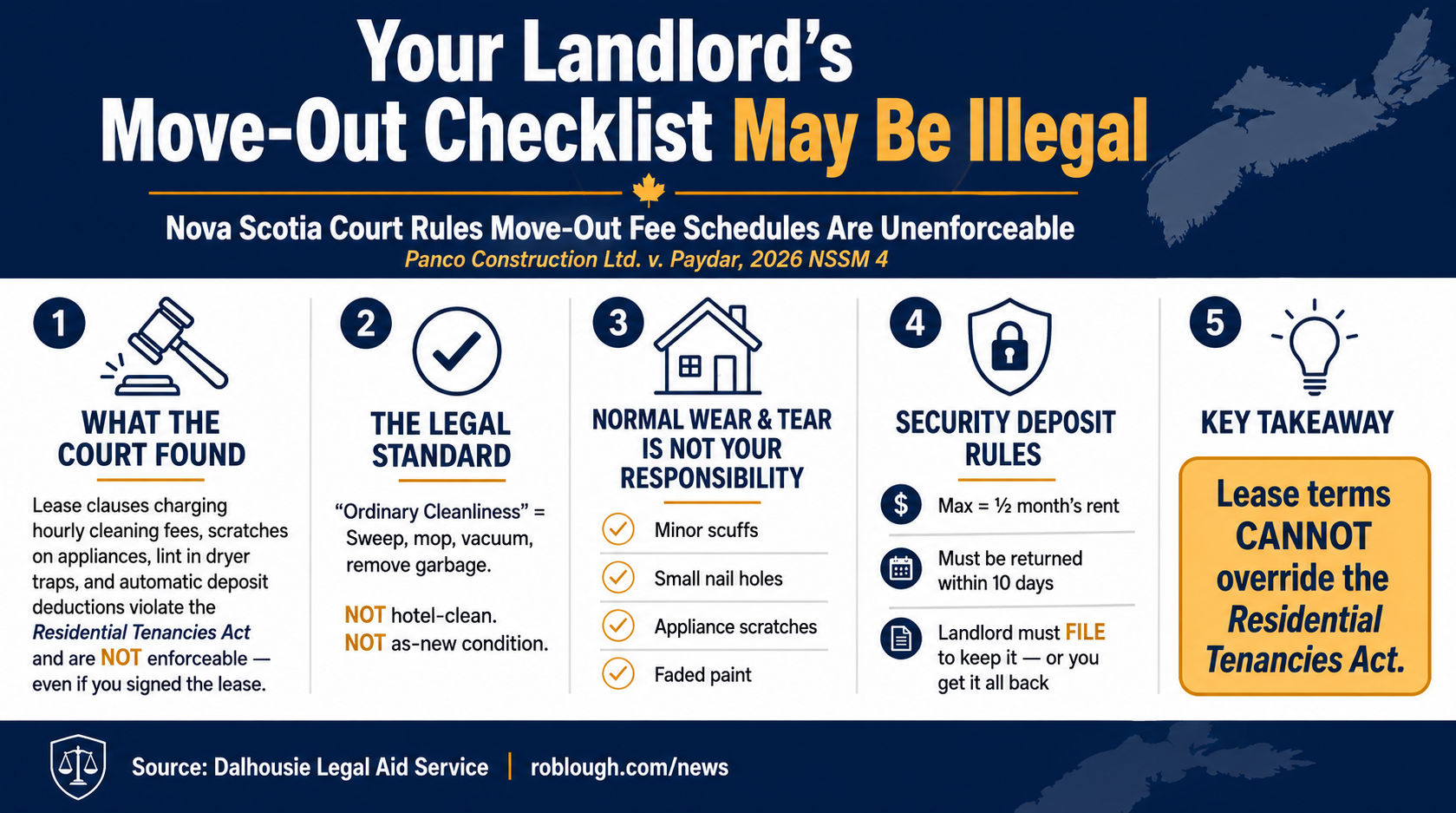
A recent Nova Scotia Small Claims Court decision has put landlords across the province on notice: lease agreements that include detailed move-out cleaning checklists, preset hourly labour charges, and automatic deductions for scratches and minor wear violate the Residential Tenancies Act (RTA), and are completely unenforceable.
The case, Panco Construction Ltd. v. Paydar (2026 NSSM 4), involved a Halifax-area landlord attempting to keep a tenant's $1,100 security deposit by applying a multi-page move-out fee schedule embedded in the lease. The Court rejected the landlord's claim entirely and ordered the full return of the deposit.
If you are a tenant in Nova Scotia, or a landlord reviewing your lease agreements, this decision matters.
What Happened in Panco v. Paydar?
The landlord in this case had included a detailed fee schedule directly in the lease. It listed charges for items like:
- Cleaning floors, ceilings, and walls
- Lint found in the dryer trap
- Scratches on appliances
- Hourly labour rates for cleaning and minor repairs
- Automatic deductions from the security deposit at move-out
These clauses are not unusual. Landlords across Nova Scotia, and across Canada's broader rental market, have been embedding similar fee schedules into residential leases for years, often without tenants realizing the clauses cannot be legally enforced.
The adjudicator in Panco v. Paydar was direct in the ruling. The fee schedule provisions were found to be:
- "absolutely contrary to the RTA"
- "not enforceable"
- Clauses that "should not be included in any residential lease in Nova Scotia"
The language is unusually strong for a Small Claims decision. It signals that this is not a borderline or fact-specific outcome, it is a clear statement of law.
What Does the RTA Actually Require at Move-Out?
Under the Nova Scotia Residential Tenancies Act, a tenant's only cleanliness obligation at move-out is to return the unit to a state of "ordinary cleanliness." That's it.
Nova Scotia courts have been refining this standard for years. In Armco Capital Inc. v. Saunders (2021 NSSM 10), the court defined ordinary cleanliness as: sweeping, vacuuming, mopping floors, and dealing with garbage appropriately. In Tagliapietra v. Cake (2023 NSSM 33), the court went further, clarifying that the threshold is simply that the unit is returned to a level where someone else can begin living there.
Not hotel-clean. Not "as-new." Just habitable.
Deep cleaning is the landlord's responsibility not the tenant's. The security deposit can only be used to bring a unit back to ordinary cleanliness, not to fund a professional deep clean, a restoration project, or the kind of immaculate condition that would earn a five-star review on a short-term rental platform.
What About Wear and Tear?
Panco v. Paydar also reaffirmed that landlords are not entitled to receive a unit back in the same condition it was in on the first day of the tenancy. The longer someone lives in a unit, the more wear and tear is expected and the tenant is not responsible for it.
Nova Scotia courts have consistently recognized the following as ordinary wear and tear:
- Scratches on appliances
- Minor scuffs on walls and baseboards
- Small nail holes from hanging pictures
- Faded or worn paint
- Smoking-related repainting, where no no-smoking clause existed (Jebailey v. Nickerson, 2018 NSSM 54)
A landlord who charges for any of these items is operating outside what the RTA permits, regardless of what is written in the lease.
"But I Signed It" Why That Doesn't Matter
One of the most important takeaways from this decision is that a signed lease cannot override the Residential Tenancies Act (RTA).
The RTA sets a floor for tenant protections in Nova Scotia. Any lease clause that attempts to remove those protections, or impose obligations beyond what the Act allows, is automatically void and unenforceable, even if a tenant signed the document.
This is why pet deposits, key deposits, and cleaning fees added on top of the security deposit are all illegal in Nova Scotia, even when they appear in a signed lease. Panco v. Paydar applied this principle directly: the fee schedule was an unlawful attempt to circumvent the legislative standard, and signing the lease did not make it binding.
This matters especially in a housing market like Halifax-Dartmouth, where rental demand remains elevated and tenants are often in a weaker negotiating position when signing leases. The law provides a baseline that cannot be bargained away.
The Security Deposit Rules: What Landlords Can and Cannot Do
Nova Scotia's RTA has strict rules about how security deposits work:
| Rule | Details |
|---|---|
| Deposit cap | Cannot exceed half a month's rent |
| Return deadline | Must be returned within 10 days of move-out |
| Allowed deductions | Unpaid rent; actual damages beyond normal wear and tear |
| Not allowed | Flat cleaning fees, preset charges, wear and tear deductions |
| Required process | Landlord must file Form R within 10 days to retain any portion |
| No application = no deduction | If the landlord misses the 10-day window, the full deposit must be returned |
If a landlord fails to either return the deposit or file the appropriate form within 10 calendar days of the tenancy ending, the tenant can file a Form S with the Residential Tenancies Program to recover it, even if there was actual damage to the unit.
The 10-day deadline is hard. There are no extensions.
What This Means for Nova Scotia Tenants
If your landlord is relying on a move-out fee schedule or checklist, here is what you need to know:
Ordinary cleanliness is the standard. Sweep, mop, vacuum, remove garbage. That is your legal obligation at move-out. You have met the RTA standard.
You are not responsible for wear and tear. Scratches, scuffs, small nail holes, and faded paint are expected consequences of someone living in a home. Courts will not award a landlord compensation for these items.
Preset fee schedules in leases are unenforceable. Panco v. Paydar confirms this directly, using unusually clear language. If your lease has one, it cannot be applied against your deposit.
Deep cleaning costs belong to the landlord. If a professional clean is required beyond ordinary cleanliness, that is a cost of doing business, not a cost to pass to the tenant.
A signed lease does not make an illegal clause enforceable. The RTA governs. Lease terms that contradict it are void.
If your deposit is not returned within 10 days, file a Form S immediately. Do not wait for your landlord to contact you first.
What This Means for Nova Scotia Landlords
The adjudicator's language in Panco v. Paydar is unusually direct. These clauses "should not be included in any residential lease in Nova Scotia." This is not a grey area.
Landlords who continue including move-out fee schedules in their leases risk:
- Losing security deposit claims entirely at a Residential Tenancies hearing
- Being ordered to pay general damages of $250 to tenants for improperly handling a deposit (Armco Capital Inc. v. Saunders, 2021 NSSM 10)
- Potential summary conviction under section 23 of the RTA, which carries a fine of up to $1,000 (rarely enforced, but the provision exists)
Landlords can legitimately document actual damage with dated photographs, require repairs for genuine harm caused by tenant negligence, and deduct costs supported by invoices and receipts, but only through the proper Form R and Residential Tenancies hearing process.
In a rental landscape where vacancy rates and affordability pressures continue to shape the market, maintaining proper, compliant lease agreements is both a legal obligation and a practical protection for landlords as well.
A Pattern of Pro-Tenant Decisions in Nova Scotia
Panco v. Paydar is not an outlier. Nova Scotia courts have been building a consistent body of case law that protects tenants from lease overreach:
- Armco Capital Inc. v. Saunders (2021 NSSM 10): Defined the ordinary cleanliness standard; confirmed general damages for improper deposit handling
- Tagliapietra v. Cake (2023 NSSM 33): Clarified that move-out threshold is habitability, not condition at tenancy start
- Bray v. Denny (2018 NSSM 50): Recognized picture holes and repainting as ordinary wear and tear
- Jebailey v. Nickerson (2018 NSSM 54): Smoking-related painting is normal wear and tear absent a no-smoking clause
Together, these decisions form a clear framework: Nova Scotia courts will not allow lease language to impose a standard of care higher than what the RTA requires and they will order deposits returned when landlords attempt to do so.
This pattern reflects a broader provincial reality. With major new housing supply entering the Halifax market and rental dynamics continuing to evolve, tenant protections under the RTA are being applied with increasing clarity and consistency.
The Bottom Line
Panco v. Paydar is a significant decision for Nova Scotia's rental market. If you are a tenant, know your rights: ordinary cleanliness, no responsibility for wear and tear, and a 10-day clock your landlord cannot ignore. If you are a landlord, review your lease agreements now, move-out fee schedules are not just unenforceable, they are a liability.
If you are facing an unfair security deposit dispute, contact Dalhousie Legal Aid or the Nova Scotia Residential Tenancies Program for help.
Resources
- Dalhousie Legal Aid Tenant Rights Guide
- Nova Scotia Residential Tenancies Program
- Form S (Return of Security Deposit): Available via the NS Residential Tenancies website
- Panco Construction Ltd. v. Paydar, 2026 NSSM 4 — available via CanLII and the NS Courts decisions database
Related Resources
- Nova Scotia's Rental Market: How It Differs from the Rest of Canada
- Canada's Rental Market Cooling: 14 Consecutive Months of Falling Rents
- Halifax-Dartmouth Market Update — January 2026
- Nova Scotia's $300M Housing Partnership: Shannon Park, Dartmouth
Rob Lough is the Broker/Owner of Century 21 Optimum Realty, serving Halifax-Dartmouth, East Hants, and the Truro/District 104 corridor. He has 25 years of Nova Scotia real estate experience. This article is provided for general information purposes and does not constitute legal advice. Tenants and landlords with specific questions about the Residential Tenancies Act should contact Dalhousie Legal Aid or a qualified Nova Scotia lawyer.