
The New First-Time Home Buyers' GST Rebate
The New First-Time Home Buyers' GST Rebate: What It Means for Buyers, Sellers, and Agents in Nova Scotia
By Rob Lough | Broker/Owner, Century 21 Optimum Realty | Halifax-Dartmouth, Nova Scotia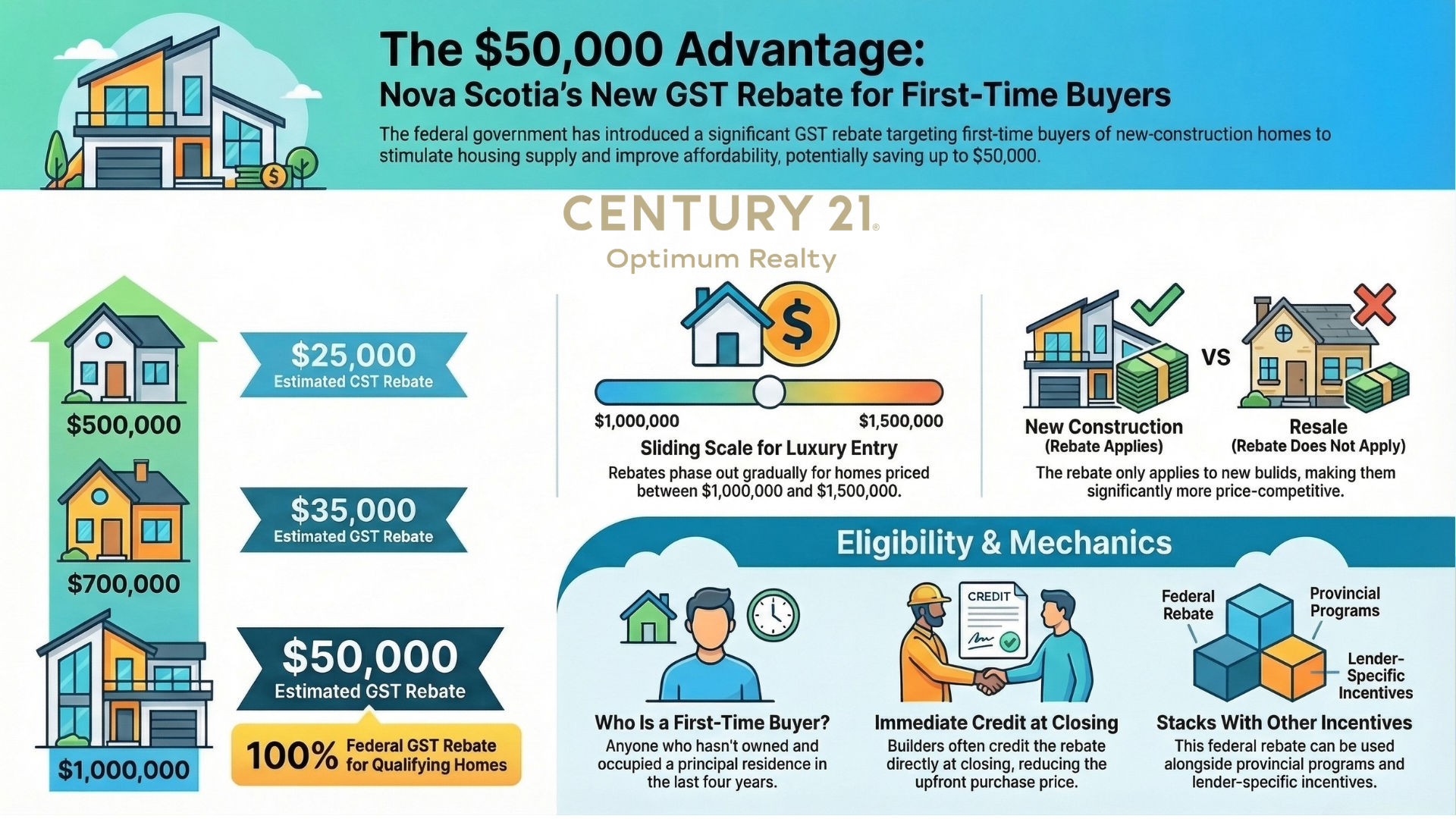
Ottawa has just handed first-time buyers of new construction one of the most meaningful affordability tools in a generation, a GST rebate that can put up to $50,000 back in a buyer's pocket. If you're a first-time buyer on the fence about new construction, a seller wondering how to compete, or an agent looking for a timely conversation starter, this change deserves your full attention.
Here's a plain-language breakdown of what the new First-Time Home Buyers' GST Rebate actually does, who qualifies, and how it reshapes the buying conversation in Halifax-Dartmouth and across Nova Scotia right now.
What Changed and Why It's a Big Deal
For years, Canada's federal new housing rebate was a modest instrument. It topped out around $6,300 and phased out at relatively low price points that had long since fallen below the realities of most urban new-construction markets. For buyers in Halifax, Dartmouth, or communities like Truro and the Annapolis Valley, the old rebate was often barely visible at closing.
The new First-Time Home Buyers' GST Rebate is a different animal entirely.
Under the updated program:
- Full rebate (up to $50,000): Applies to qualifying new homes priced up to $1,000,000. The rebate covers 100% of the GST — or the federal portion of HST — actually paid on the purchase.
- Partial (sliding) rebate: For homes priced between $1,000,000 and $1,500,000, the rebate phases out gradually rather than disappearing at a cliff edge.
- No rebate: Homes at or above $1,500,000 are outside the program entirely.
In practical terms, a first-time buyer purchasing a qualifying $1,000,000 new build could save the full $50,000 in GST, a number large enough to cover a down payment upgrade, offset closing costs, or fund early renovations. That is not a marginal adjustment to affordability. That is a structural shift.
Why Ottawa Did This and Why Now
The federal government introduced this rebate with a specific goal: thaw one of the slowest housing markets in recent memory. Buyer hesitation has been widespread. Rising costs, elevated interest rates through 2023–2024, and the affordability gap between new builds and resales have kept many first-time buyers on the sidelines.
By targeting the GST specifically, a tax that falls entirely on new construction and not on resales, Ottawa is trying to accomplish two things at once. First, make new homes more price-competitive relative to the resale market. Second, stimulate new construction demand and accelerate housing supply at a time when Canada needs both.
If you've been tracking the Halifax-Dartmouth market stats for January 2026, you know what "slow" looks like locally: days on market pushing past 52 days, sold-to-ask ratios slipping to 97%, and buyers finally getting breathing room they haven't had in years. The GST rebate lands squarely in that environment, a policy-driven window that buyers and their agents should understand now, before spring activity picks up.
How the Mechanics Actually Work
This is where many buyers (and some agents) get fuzzy, so let's be specific.
Who qualifies as a first-time buyer? The program targets eligible first-time home buyers generally, those who have not owned and occupied a qualifying home as their principal residence at any point during the four years before the purchase. The definition tracks closely with the existing federal first-time buyer framework, but buyers should confirm their specific status with a lawyer or tax professional.
What homes qualify? The rebate applies to newly built or substantially renovated homes, not typical resales. This is a deliberate policy choice to channel incentives toward new supply rather than existing inventory.
How is the rebate delivered? In many cases, builders credit the rebate directly on the statement of adjustments at closing, then claim it back from the CRA. This means qualified buyers see the savings as a reduced effective purchase price at the time of purchase, rather than waiting months for a post-closing government refund. That distinction matters a great deal to buyers managing tight closing budgets.
Does this stack with other programs? Potentially, yes and that stacking potential is one of the most compelling parts of the story for Nova Scotia buyers. The GST rebate is a federal measure, which means it sits alongside existing provincial programs, lender incentives, and other federal affordability tools. Buyers working with an experienced agent and mortgage professional should be mapping out all available incentives together, not treating each in isolation.
What This Means for First-Time Buyers in Nova Scotia
For buyers who have been watching new townhouses and condominiums come to market in Halifax, Dartmouth, Bedford, or communities along the 104 corridor near Truro and who have been hesitating because of the pricing gap between new construction and comparably sized resales, this rebate changes the math.
Consider a qualifying new townhouse at $700,000. The 5% GST on that purchase is $35,000. Under the new rebate, a qualifying first-time buyer gets that $35,000 back, effectively at closing, in most builder transactions. That's a payment directly to affordability in a market where every dollar of closing cost pressure matters.
A qualifying new condo or entry-level detached home in the $500,000–$600,000 range carries $25,000–$30,000 in GST. Again: gone, for eligible buyers. That's a figure that closes the gap between new and resale options in a very tangible way.
As you research your options, you'll want your financial foundation in order. Understanding your credit score and what lenders look for is one of the most important preparation steps before entering any purchase negotiation, new build or resale.
What This Means for Sellers
The GST rebate does not apply to resale properties, but that doesn't mean resale sellers can ignore it. In fact, sellers of existing homes need to understand the competitive dynamic it creates.
When a first-time buyer can save $35,000–$50,000 on the purchase of a qualifying new home, the pricing calculus between new builds and resales shifts. A resale seller pricing a home in the $700,000–$900,000 range in a market like Halifax-Dartmouth is now competing with new inventory that effectively costs the buyer significantly less than the sticker price suggests.
That doesn't mean resales lose location, lot size, established neighbourhoods, immediate move-in availability, and no construction risk are real advantages. But it does mean that pricing strategy, presentation, and incentive structuring matter more than they did six months ago. Sellers who understand this dynamic, and work with agents who can help position their listings accordingly, will be better equipped for the spring market.
For context on how current pricing conditions are stacking up, the Halifax-Dartmouth market report is updated monthly and worth reviewing before setting a list price.
What This Means for Agents and How to Use It
The First-Time Home Buyers' GST Rebate is more than a policy update. It is a conversation catalyst.
Here's how effective agents should be using it right now:
Re-engage cold buyer leads. Any first-time buyer who paused their search over affordability concerns has a new reason to revisit the numbers. A simple, specific message: "A qualifying new home at $700K just got $35,000 cheaper for you, here's how", is the kind of concrete, policy-driven reason to restart a stalled conversation.
Educate sellers on the competitive landscape. The agents who earn long-term trust aren't the ones who just talk about the listing, they're the ones who help sellers understand the full picture. That includes how the GST rebate affects new-build demand and what it means for resale pricing in their segment.
Work new-build projects into your buyer conversations. Agents who are familiar with qualifying builder projects in their market can now position select new construction as not just a housing option but a tax-advantaged opportunity for first-time buyers, particularly for entry-level townhouses and condominiums that fall well within the $1,000,000 full-rebate threshold.
Position yourself as the navigator. The rebate is powerful, but it has eligibility conditions, builder-specific delivery mechanics, lender coordination implications, and legal paperwork implications. Buyers who try to capture it on their own may miss steps. An agent who can coordinate with the buyer's lawyer, mortgage broker, and the builder's team to make sure the rebate is correctly applied at closing is delivering something genuinely valuable, not just information, but execution.
For a comprehensive look at what the buying process involves in Nova Scotia, the Buyers Info resource on this site covers the process from budgeting and mortgage pre-approval through to closing.
The Bigger Picture: Affordability Is Being Rebuilt in Layers
The GST rebate doesn't exist in isolation. Ottawa and provincial governments across Canada have been layering affordability programs, changes to mortgage rules, extended amortizations, expanded down payment assistance frameworks, and now a tax rebate specifically targeting new construction. For first-time buyers in Nova Scotia, understanding how all of these pieces fit together is the difference between a purchase that strains your budget and one that sets you up for long-term financial stability.
That's why working with a knowledgeable guide matters. Not just someone who can show you houses, but someone who can show you the full financial picture, help you compare new builds to resales under the new rules, run the actual numbers for your qualifying purchase, and connect you with the lender, lawyer, and builder who will make sure the rebate is captured correctly.
Ready to Talk Through Your Options?
Whether you're a first-time buyer exploring new construction, a seller assessing how your listing competes in this environment, or you just want to understand how the GST rebate applies to a specific property or project you've been watching, this is exactly the kind of conversation worth having before the spring market arrives.
Contact Rob Lough at Century 21 Optimum Realty. With 25 years of real estate experience in Halifax-Dartmouth and across Nova Scotia, I'm here to help you cut through the noise and make a confident, well-informed decision.
Related Resources
- Halifax-Dartmouth Real Estate Market Statistics — January 2026
- Monthly Market Report — Halifax-Dartmouth & Nova Scotia
- Buyers Info: Everything You Need to Know Before Buying in Nova Scotia
- What Is a Good Credit Score in Canada for Getting a Mortgage?
- Bank Appraisal vs. Real Estate CMA: What Every Homeowner Needs to Know
- Nova Scotia Property Tax Guide
Rob Lough is Broker/Owner of Century 21 Optimum Realty in Halifax-Dartmouth, Nova Scotia. He has 25 years of real estate experience, including 5 years as a licensed Home Inspector, and serves buyers, sellers, and investors across Halifax Regional Municipality, East Hants, and the District 104 Truro corridor.